Saturday, September 6, 2014

"As You Sow..."

Blog Post #17

Jean-François Millet, The Sower

My mother-in-law had her own twist on the old proverb "For whatsoever a man soweth, that shall he also reap,” (Galatians 6:7). With delight, she often showed me pieces of fabric she planned to use for new dresses. One fabric she particularly liked had a small print of little cowboy boots, horses, and spurs on a navy blue field. She liked this fabric because it suggested something dear to her—her late husband, who had passed away a year or two earlier.  Horses and cowboy boots were synonymous with Dad.

The cowboy print looked something like this

Dad with his horse Smokey

She used the same dress pattern many times, changing the print of the fabric for variety.  Soon after she showed me the cowboy print, it became a dress much like the one she's wearing in the picture below.

My mother-in-law wearing a
typical dress of her own making

One day, not long after my husband and I had married, his mom emerged from her sewing room and laughingly shared with me the truism she had just thought of as she began to repair a mistake in her sewing: 


“Whatsoever a woman seweth, that shall she also rip!” 

This became shortened  to, “As you sew, so shall you rip,” which is how I always think of it. Her witticism seemed to make up for any error in sewing she had made. She knew she had struck on a profound play on words. Always chuckling at her wit, she repeated this phrase to me whenever I found her sewing.


The notorious seam ripper


It was simply brilliant. And so true. I have thought of it plenty of times since as I’ve sat at my own sewing machine frantically rushing to repair a mistake by wielding my trusty seam ripper. I have never been a patient seamstress. I like sewing. I do. But mostly the thing I like about sewing is being done. I like the finished product—wearing, displaying, or using it. Sewing is a means to an end.


My daughter Caity sews for a living. Her business keeps her extremely busy, with deadlines that often require additional help, (which I am pleased to provide). We sit together sewing for hours at a time, or I do odd jobs to expedite the orders she has to fill.
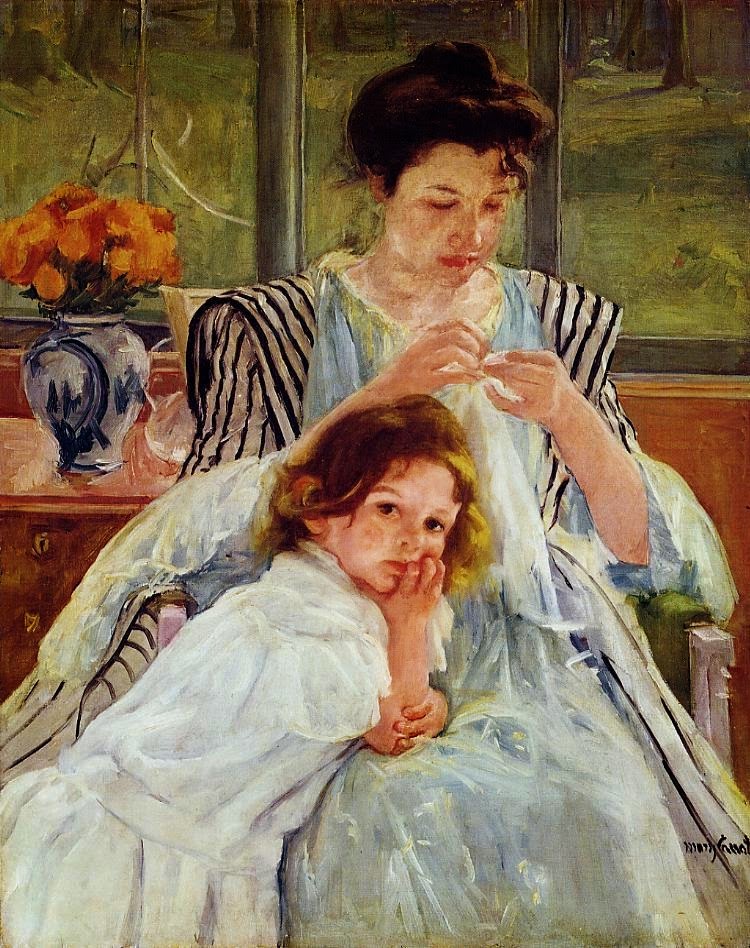
"Young Mother Sewing" by Mary Cassatt

Caity does impeccable work. Running her business online via an *Etsy shop means her clients must take their own measurements. This can create problems if done incorrectly. Sometimes, items are returned for adjustments. Fortunately, this is the exception, not the rule. Making adjustments is time-consuming and generally without remuneration.


At times, she asks me to remove a bodice (the top portion of a dress) from the skirt. Recently, I had two such dresses to take apart. On one of the dresses, the length of both sleeves and skirt had been miss-measured by the customer, and the dress returned for adjustments. The fully lined mutton sleeves—having two parts—also needed to be dissected and refinished.

Dresses with mutton sleeves.
Not the dresses Caity makes.

Looking at one of the sleeves, I saw a possible shortcut to repairing the hem of the lower sleeve without having to rip the sleeve apart. But I was strictly instructed that no shortcuts were allowed. Caity, having already attempted a shortcut in refinishing the sleeve at the proper length in a thoroughly acceptable way, received word from the customer that she preferred the sleeves refinished the original way.  The fabric would need re-cutting, and the sleeve, re-made from scratch. It had to measure up to a high level of quality and workmanship, and it did. Her customers are happy, and she feels peace and confidence in her product, and, truthfully, in herself. 


I balked at the thought of this, knowing the extra time and effort it would take. But Caity was adamant. I tore out the stitches, while reciting to myself the slightly altered form of the already misrepresented adage, “As you sew, so shall I rip.” True. So true. We reaped as she sowed (and as she sewed).


I’ve watched Caity in her preparations to sew her custom designs. Because she does work with a handicap—the customer’s measurements—she takes precautions to help insure a perfect fit (and achieves this feat at least 95 % of the time). I’ve watched her measure, and re-measure, two and three times before cutting.  She carefully lays-out, and pins pieces together, instead of doing it her mother’s less exacting and speedier way. In doing so, she saves the time I waste picking out mistakes. Because she makes costumes that multiple people may wear, she allows for discrepancies and variances in size by including an expandable panel in her designs. I’ve watched the great care she takes in her craft and marvel at how few mistakes she makes. It is truly remarkable, considering the queen of “just get it done as fast as possible” was her first (and only) sewing instructor. (Yes, I speak of myself. I grimace as I admit this. But it is true.)


“…Whatsoever a man soweth, that shall he also reap.” True of everything, not just sewing. This summer is full of illustrations: I neglected to deadhead my roses, and have had few to any blooms. The basil, too, I’ve neglected, and have nothing but sad and scraggly plants gone to seed with which not to make pesto. I have giant “thistles” instead of artichokes, because I failed to harvest. We have a sad little avocado tree that was sown in what must be a cursed bit of soil, for the tree, (and its earlier counterpart, which we uprooted because it also fared poorly) has turned into a skinny, leafless stem. I have reaped as I have sown. No doubt about it.


There are many ways to sow. Sowing faithful and true relationships is paramount if you wish to reap a harvest of love and harmony. Sowing good works brings joy and fulfillment. Sowing things of the spirit brings a harvest of knowledge, truth, and peace. Of course, it’s possible to sow things that reap a poor harvest. Sowing seeds of laziness, self-indulgence, pride, and deceit all reap thriving harvests, but who wants grubs and sewage in their horn of plenty?  


For me, it was a particularly hot and humid summer—a particularly busy one, as well. We were busy sowing other than in our vegetable garden. One of our daughters and her family came to stay after being pruned and uprooted from the bit of soil where they had been planted for several years. Their former house sold, they stayed with us during the summer until they found a fruitful spot of ground in a happy situation less than an hour away. Transplanted and thriving--is this not a worthwhile harvest?


Add to that, the sowing and the reaping (or more apropos, the sewing and the ripping) with Caity, we’ve had a fruitful summer.

In sowing and reaping, time does not allow for shortcuts. It just doesn’t. If you plant a seed, it doesn’t matter how much you water it, or expose it to the proper sunlight and nourishment, it will always take a certain amount of time before it will produce. A mighty oak isn't grown in a day. You cannot rush the harvest. You might be able to encourage it, to make it more plentiful. You might even discourage it, and never reap at all.


Our daughter’s family reaped a nice, quiet, home in exactly the area they had hoped to live, but there were no shortcuts getting there. They reaped as they sowed. They might have settled for something less adequate, but there would have been a price to pay. The safe environment they were seeking, the proximity to schools, work, church, family, and access to the community would have, to a degree, been sacrificed, and with that a certain measure of peace and comfort. Patience in sowing reaps added benefits during harvest.


Brad planted tomatoes. With great care, he watched over them. He nourished and cared for them because he wanted that plentiful harvest. He reaped a lot of tomatoes—many beautiful, red, ripe and delicious. Enough to bottle and to share. He thought he might be able to extend the season further into fall by pruning back the old plants, and planting a couple new plants mid-summer. He was disappointed that his efforts really didn’t produce the desired effect. The season has run its course. The tomatoes have run their cycle—all ending at about the same time. There are things we can change, and things we cannot. I suppose he could build a greenhouse, and have tomatoes year-round, but he hasn’t chosen to do that. Everything comes with a price. Shortcuts must follow the law of the harvest. No matter what, you always reap what you sow.  

 
Jean-François Millet – "Gleaners"

Looking back on the summer, it is evident that I did not sow some of the things that I might have sown. I didn’t even sew things that I planned to sew. I’ve been talking about making a new dress since March. I still haven’t done it. It doesn’t matter. The old ones are still wearable as they hang, limp and lifeless in my closet, like vintage remnants from a garage sale. Instead, I sowed a summer with my daughter, sewing and talking, and being together. It was, and continues to be, worth the harvest, for she is precious to me.


I spent the summer with my other daughter’s family, with treasured grandchildren, laughing, talking, playing games, and building relationships that reek with happiness.

Surely these, and other important things sown over the course of the summer, were worth any displaced activities I might have harvested. Instead of basil, what have I gleaned? Much, much more—and of greater worth. An eternal harvest.

One of our daughters, and some of our grandchildren on a summer outing

One of my grandsons with me

There’s always next year for basil and artichokes. But some things you may only sow once in a lifetime. They are worth every part of the time invested, and the harvest reaped is eternal.


*Caity’s Etsy shop is called Cait’s Boutique.  You might find it fun to take a look!

© September 6, 2014


Sunday, August 17, 2014

A Wonderful Life (or, When the Best Laid Plans Take a Detour)

Blog Post # 16

George Bailey (James Stewart) "It's a Wonderful Life"


Sometimes, I feel a little like George Bailey, the main character in the 1946 film It’s a Wonderful Life. George had big dreams for his future, but a series of life events and personal choices thwarted his well-laid plans time after time. The comparison between George Bailey and my life ends there. I have never considered jumping off a bridge, nor have I had an angel step in to show me what life would be like without me. But I can relate to the detours he experienced.


When I was a little girl, I had a long list of professional aspirations that I rattled off mechanically when asked what I wanted to be when I grew up: ballerina, artist, pianist, singer, cartoonist, seamstress, interior decorator/home designer, and more. I had no qualms about pursuing all of these careers at the same time; wasn't that normal?

"Harmony" by Bessie Pease Gutman

Somewhere, in the more secure alcoves of my heart, I also knew I would be a homemaker: a wife and mother. I never thought to include marriage in my perfunctory list. I took for granted the idea that home and family would always be a part of my life, so I thought about it as much as I thought about my heart beating. It never occurred to me that there might be detours.

"Love is Blind" by Bessie Pease Gutman

Years passed. School days flew by. One by one, I discarded some of my former career choices, relegating them to mere hobbies and interests—even disinterests. I zeroed in on an artistic target. This made sense, and felt right since almost every waking moment of my youth and young adulthood was spent with a pencil in hand. Drawing was akin to breathing—an almost involuntary reflex of life.

"A Girl Writing" by Henriette Brown

During elementary and junior high school, I loved  everything Charlie Brown and Peanuts. I even wrote a personal letter to Peanuts creator Charles M. Schultz, feeling honored to receive a personal letter of encouragement in return. I narrowed my view to becoming a cartoonist, and set to work creating comic strips. At last, after acknowledging that I wasn’t the least bit funny, I discarded the idea of becoming the next Charles Schultz.


Growing into my high school years, my interest reached to include Walt Disney, a man I had always admired, and whose imagination and creativity I revered. Reading biographies of his life, studying books on The Art of Animation, and creating an animated film for a high school project, I settled on a career as an animator. When the time came, I was hard-pressed to find a college offering courses in animation. (Today, there are many schools well equipped to prepare future animators, but when I was college age, they were rare and expensive.) With youthful energy and optimism, I did the next best thing: I started working toward an art major, figuring I could work my way up from the bottom rungs of the professional animation ladder.


Again, plans changed when I met Mr. Right  (Brad), and married after completing my second year of college. Suddenly, the career that had always stood in the wings took front and center stage: I became a wife and after a year of work, a mother. (I worked that year in a hospital of all places! Off the charts when it came to where I wanted to be).


Over a period of ten years, we accumulated five little chicks in our brood. Mother Hen was now nestled into her coop and happy to be there. Difficult as it might be for a hen to hold a pencil in her feathers, hold a pencil I did! I kept drawing and imagining I might have a career as an illustrator on the side. Anyone who has been a full-time mother of five little ones knows it requires every minute of a 24-hour day.  I was content to draw pictures for my family and for church responsibilities. I made home school materials, games, toys, posters, flyers, programs, and a multitude of greeting cards and drawings that were routinely given away.


When my husband was recovering from a serious neck injury, I found part-time work from home illustrating a children’s phonetic reading series that included illustrations for over seventy-two individual books! At last, I thought, I am fulfilling my career goal as an illustrator. At first, the work was fun. The creative juices flowed freely and I spent the wee hours of the morning drawing and inking book after book while my children slept and my husband worked the night shift. It wasn’t long before the work became repetitious and tedious. The small paycheck I garnered did little to alleviate the monotony of the job. There was a sense of satisfaction in helping our little family financially, and I was doing what I thought I wanted to do—a combination of illustration and cartooning.
 
A few of the Phonetic Readers I illustrated in the early 1990s

Hindsight truly brings clarity, and with that illustration work, I realized how monotonous working as an animator—the Old-School kind, repeatedly drawing by hand the same images over and over with only small increments of change—would have been. I was grateful I had not become an animator, for I certainly would have been on the low rungs of perpetual boredom and the professional ladder.    

Teaching a cartooning class 

With some of my students

When our children grew older, I took a job at an elementary school working with special needs children. Bringing to the school setting the knowledge I had gleaned through homeschooling, and work as an associate of an educational consultant, I found multiple opportunities to use my pencil to create art. Part of my time at school was spent working one-on-one with students. The remainder was spent writing curriculum, visually modifying materials, turning our classroom into The Big Woods, or a time machine, making theme-related costumes for the kids in our class, creating large wall murals and props, teaching an extra-curricular cartooning art class, and making the library across the hall into a magical castle. It wasn’t exactly what I had dreamed of, but I did manage to serve as an artist, seamstress, interior decorator, and, oddly enough, even as a writer, all rolled into one.

My granddaughter visited our class as Laura Ingalls 

Wall in our classroom

Adjacent schoolroom wall

Education, curriculum development and writing had never once entered my mind when I was planning my list of careers as a child, yet they became the trifold center of my semi-professional life. Like George Bailey, a series of life events and personal choices dropped me into those waters, and I swam with the current.

George Bailey taking on his father's Building and Loan Business

Sometimes, the things we think we want are completely inconsistent with our true inner compass. The choices we make, even when they appear to be thrust upon us, are still our own choices. As difficult as it was, George Bailey made the decision to take over his father’s position at the Building and Loan office. While I had touted becoming an animator for a decade, there was certainly no coercion involved when I chose to get married instead. I chose to have children, to home school, and to take a job at the elementary school. As I seized these new opportunities, I always found ways to assert my personal gifts, and develop my interests.  I didn’t abandon the things I loved and wanted to do, I just adjusted the hats I wore when doing them, and added new interests, new horizons, new understanding, and potential skills along the way.


Through these detours, I learned I was capable of new, enjoyable and interesting things; things that were true to my inner compass. Things I had never before considered. One of the things I discovered as a result was how much I loved to write.


Hindsight is a great crystal ball. Reflecting on my past, I have been astounded at all the overlooked, misunderstood indicators in my life that pointed to writing as something I would enjoy! As a child, I spent part of my summer writing a newspaper that included crossword puzzles, recipes and stories. Over the years, I wrote, illustrated and bound many small books with hand-stitched pages for fun, and as gifts for  family members. When ten years old or so, I wrote little chapter books we now drag out every decade or two for a good laugh. One was a Nancy Drew knock-off, the others original inventions. I took copious notes all through school, and enjoyed writing poetry, and creative writing assignments. I wielded my pencil without connecting the dots that writing was as enjoyable and important to me as drawing. Strange, how I could be so blind to my own preferences.  
 
A few childhood attempts at writing
And the point of writing all this is…..? The truth is, I didn’t set out to write any of this. I sat down in front of a blank page and gave my hands permission to start typing--just for fun. And they did. For me, writing presents those rare moments when I don't feel I have to meticulously plan everything out. 


I seldom know exactly what I’m going to write about. It’s often a surprise--full of detours. Often, topics I’ve dutifully outlined in advance struggle for a permanent position on the page. Instead of flowing, they almost immediately clog in a P-trap of muddied, stale, over-ripe thoughts and ideas. But those times when words flow out like pure waters from a pristine spring—fresh, clear, and illuminating--make writing an adventure and a joy! I discover things about myself, and things about others. I discover things I know, and things I didn’t know I knew. I discover hidden things, too—metaphors and analogies about life that develop word by word, like Polaroid snapshots.  


Polaroid camera and undeveloped picture


It’s good to have a plan. It’s good to aspire to worthy goals.  I believe these principles and try to live by them. It can also be good to allow for a change of plans—to see opportunities, tendencies, and desires less rigidly. Sticking to Plan A may just turn out to be a dead end, where Plan B, or C may lead to multiple doors opening to broader growth, unforeseen talents, and increased joy. Sometimes those doors are thrust upon us, and sometimes we can’t see where the door will lead. Some doors we may bolt shut because we’re too proud to admit that a door that’s different from the one of our choosing might be better. There’s always a choice involved. That choice may be as small as opening the door and walking through it, which brings us back to George Bailey.

George Bailey's plans

George Bailey had plans—big plans! He also had choices. Compassion drove his decisions, the consequences of which sometimes caused him frustration and even despair.  But the detours he encountered also further developed and refined the goodness of his character, leading to a bevy of faithful family and friends. An illuminating door was opened—to see life without him in it—and with that epiphany, every door that led to life--regardless of pitfalls and setbacks, no matter how far from his plans—looked good to him.
 
The angel Clarence gives George a chance to see life without him in it

Like George Bailey, I began early on making plans. Big plans. My life has been full of twists and turns, and like George Bailey, around every corner there have been choices—hard choices. I have to say that, although I’m not at all where I once thought I would be, I’m so glad I’m where I am. I suspect the plans I have—that we have (Brad and I)—may detour again—in fact, we’re riding a detour right now that has brought countless joys and blessings.


Thanks, George Bailey, for reminding us that though life may not turn out as we planned, it really is a wonderful life.

© August 16, 2014


Thursday, July 31, 2014

"Bridges"

Blog Post #15


bridge1
brij/
noun
noun: bridge; plural noun: bridges

1.    a structure carrying a road, path, railroad, or canal across a river, ravine, road, railroad, or other obstacle.
"a bridge across the river"


·       something that is intended to reconcile or form a connection between two things.


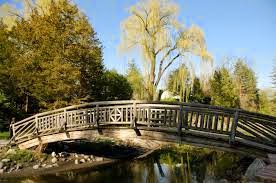
The other day, I passed a house that had a cute little footbridge spanning a faux rock creek bed in the front yard. After stopping to admire the scene for several seconds, I continued my errand, all the while wondering why the addition of the little wooden bridge made the scene so engaging, and if I would have even noticed that yard without it.


I think quaint, old, weathered bridges of wood or stone are charming and picturesque. Beginning in childhood, if I came upon a bridge—even if it was merely a flat slab of stone laid across a muddy flow mixed with rain-gutter run-off—I felt almost compelled to cross it, (provided it was wide enough for a generally klutzy person such as I to maneuver across without losing my balance and tumble into the mire). Let me note that a narrow, fallen log traversing a coursing river five or six feet above the waterflow does not have the same effect on my psyche. I am more inclined to take a picture of my wildly coordinated husband and children in such a scene than race to cross it myself.)
 
Narrow, & slippery with moss: Unsafe.

Wide, with railing: Safe.

Still, any footbridge that looks relatively safe calls to me, and I will go out of my way to cross it. If not to cross it, then to stand on it, leaning delicately on the railing, daydreaming and feeling picturesque myself—like a willowy fairytale figure who had lightly skipped to the rail, lingering there before flitting off, butterfly-like. (Then, someone really does snap a picture. When I see it, there is immediate shock and dismay. The picture my imagination took was, by far, more enchanting and attractive than the real thing. Instead of a graceful nymph bathed in soft, glowing light sprinkled with magical pixie dust, there—in the harsh reality of day—is the image of a frizzy-haired, T-shirted housewife leaning ponderously on the railing, as if every ounce of energy spent plodding along to the bridge had been exhausted, and its sole purpose was to bear her up.)


Bridge scene from "The Lord of the Rings": Arwen and Aragorn


Nevertheless, being on a bridge transforms me inside. There’s something mesmerizing about standing on a bridge watching the water gently pass beneath, with its floating cargo of leaf boats and twig sprites frolicking blithely along.  


There’s something emotionally stirring about bridges. Moviemakers apparently think so. How many scenes of a romantic, tense, or threatening nature culminate on a bridge? (The Bridge Over the River Kwai, Anna and the King, The Music Man, It’s a Wonderful Life, Sabrina, Gone with the Wind, The Lord of the Rings, and The Bridge to Terabithia are just a few with moving scenes that occur on a bridge.)
 
Jimmy Stewart as George Bailey in "It's a Wonderful Life"


Bridges have also inspired many songs. What child hasn’t heard the 17th century nursery rhyme about the ill-fated London Bridge? Everyone who lived in the late 1960s knew the fictional Billie Joe McAllister jumped off the Tallahatchie Bridge (Ode to Billie Joe by Bobbie Gentry), while Simon & Garfunkel’s Bridge Over Troubled Water moved listeners with the power of friendship.

Ancient London Bridge

A bridge, in very name, is more than a physical structure. It is a symbolic manifestation of its purpose. Maybe that’s the reason for my connection with bridges. Because they connect. They bridge gaps, overcome obstacles, link together, span chasms, and simplify journeys. Life is replete with obstacles—both physical and emotional. We step to the edge, and hope for a bridge to help us across. Sometimes, we wade in the muck before a large flat stone appears that provides a means of stepping up, and out.


I find it interesting that an arch bridge has no structural integrity until the stones meet in the middle at the keystone. It’s in the meeting of the two sides that gives the bridge its strength. Because placing the keystone can be a tricky business, scaffolding or other means of support are required to aid in construction. Once in place, an arched bridge needs no mortar to hold it together, and may stand for millennia.
 

Arkadiko Bridge, Greece - oldest standing arch bridge


Ca. 1300-1190 BC


So true of people, too.  Once the keystone of a relationship is in place, it can stand the test of time. Obstacles of differing viewpoints, backgrounds, and habits flow like water under the bridge when people have struggled through building the abutments of a relationship and recognize the inherent keystone of worth in each other. In forming a bridge with someone, we bear one another’s burdens, we meet eye-to-eye, we understand through experience, we withstand tension, we create an equally firm and binding yoke that provides safe passage. Those relationships take on the substantial, but charming quality of a quaint old bridge: pleasing, aged, tried, solid, and true. Clinging, trailing vines of laughter, endurance, thoughtfulness, and kindness adorn and beautify life’s bridges, adding a cheering, optimistic aspect.


I suppose the bridge, the brook, and the flora and fauna might have been viewed from the riverbank. They make a pretty scene from any angle. However, I prefer to step on the bridge, to linger there, and to, eventually, cross over. Crossing to the other side to see from all angles makes the experience complete. 


© Copyright July 31, 2014