Showing posts with label Beauty. Show all posts

Friday, May 22, 2015

Duet


Blog Post # 27 
P00578-The_piano_duet
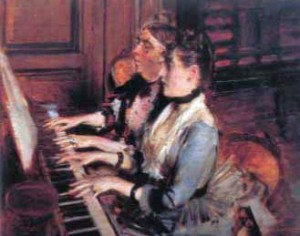
I just returned from practicing a piano duet with a wonderful friend who loves the sweet cadences and depth of feeling that pour from heart to fingers to keys to ears as much as I do. What an absolute joy to share one piano keyboard to make beautiful music together!
Mommy Amanda Duet 2
Hands: my mother’s and my       niece’s.      Duet.
When my sister, Karen, and I were young, we often “jammed” at the piano, later adding other instruments to the mix. It was at the piano that we learned to sync our hands and hearts. From Chopsticks, and Heart and Soul, we graduated to our own rendition of a tune from the now defunct Disney attraction, Country Bear Jamboree, banging out the song with knee-slapping, joyful abandon. We felt the other’s timing and touch so well, we could duplicate the unison parts with perfect accuracy. This translated to other parts of life: finishing each other’s sentences, and reading each other’s thoughts from across the room.
mompiano
My mother during her college days
It was my mother’s love of music, combined with her proclivity toward the piano in particular, that bred a long line of piano players among her posterity. Duets were a natural outcropping from the bedrock of piano-loving family members, and remind me of a time when my mother was still alive. She was a fine pianist and loved to play hours at a time. I recall falling asleep to piano sonatas and waking on a Sunday morning to sacred hymns. I would come home from school to find my mother and one or the other of her two piano-playing friends at my mother’s baby grand, their hands executing complicated dance moves as they flew across the ivories revealing a classical masterpiece arranged for four hands. I knew the expectation—I was to wait until they stopped before interrupting them for anything, with the exception of an emergency. Some of those pieces lasted ten or fifteen minutes—a long time to wait for an anxious young mind. After waiting what seemed an eternity, I finally interrupted—Sheryl had been hanging on the phone wondering if I could come over to play! If that wasn’t an emergency, I don’t know what was!
Album 03-018a Veneta at her beloved piano, 1946
My beautiful mother, perhaps playing Liebestraum or the Harp Etude so many years ago…
When I grew older, my mother invited me to join her playing piano duets. She had high standards of excellence, and insisted I fix any technical errors at the very moment they were discovered—repeatedly playing a bar or two until I had mastered the phrase. I was never technically adept, but I made up for it with unsurpassed expressivo (feeling), for I certainly felt the beauty and emotion of the music, even if I couldn’t always play the notes correctly. Still, she wanted me by her side, and over time, I improved.

images b0367-2-150dpi
After I had a family of my own, my mother and I performed at a church function an involved arrangement of Stars and Stripes Forever (the famous, easily recognizable march by John Phillip Sousa). It was a marvelous experience! I think the rehearsing was as much or more fun than the performance. A unique kind of bond forms when playing piano duets. There’s something about triumphing over difficult passages, hearing rough sight-reading sessions resolve into a harmonious whole, and feeling the emotional drama unfold with dynamic expression. I think the most satisfying part is when you feel an emotional connection to the music, and you know that an entirely different person sitting next to you is also feeling the music in exactly the same way you are, because you can anticipate and respond to what they’re feeling with perfect harmonious unity. (This doesn’t necessarily mean every note is perfectly executed, or that there is flawless technique. It means that two individuals are, for the moment, one in spirit.)
Amanda MommyDuet
Amanda playing duets with her grandmother.                                               So special.
MOmmy Amanda
Amanda with my mother.
When grandchildren came along, besides building puzzles together, and intensely competitive games of Scrabble, my mother invited them to play duets with her. While several enjoyed this privilege, one grandchild in particular latched onto this opportunity. Amanda excelled in playing the classical cadences and disciplined execution of the pieces my mother most enjoyed, which was satisfying to my mother. They made a good team, sometimes performing at church, and frequently for the family. I will venture to guess that Amanda formed a uniquely intimate bond with her grandmother through these duets.
Dogs & Primary Kids  August 14 and 25, 2005 001
My son and his wife playing piano together.
Dogs & Primary Kids  August 14 and 25, 2005 003
They really get into it!
When my own children were comfortable enough with the piano, I did my best to wrangle them into playing duets with me, however most preferred going solo. It wasn’t until my youngest daughter Caity grew adept enough to participate that I found a duet partner among my children. Even during trying and difficult teenage times, we found common ground and a laughing place sitting at the piano together. Our repertoire ranged from Mozart to Joplin—all played with equally blatant disregard for correct technique and execution. What we lost in technical expertise we made up for in expression. We loved the dynamics of the theme from Mozart’s Symphony No.40, and Burgmüller’s Arabesque. They were our wide-awake pieces. We blew threw them at Nascar speed, and with a roar to equal the revving engines! Who can resist every piano student’s favorite, Ellmenreich’s Spinning Song? We couldn’t. We dashed through it with unparalleled velocity and vigor, laughing all the way. We didn’t limit ourselves to lively pieces, however. Once, when playing an arrangement of Erik Satie’s First Gymnopèdie (which is serenity itself) we became so sleepy, we literally dozed on the bench. A much as we liked the piece, we haven’t played it since.
IMG_6924
Two of my grandchildren. When they visit, one or the other, or both are always at the piano. I LOVE IT!
I found a much simpler arrangement of Stars and Stripes Forever that usually brought up the rear flank of our duets each time we played. Racing to beat each other to the end of the unison octaves forming the introduction, we immediately stalled into a belly-scraping crawl—plodding through the bars forming the first strain. The oom-pah-pahs in the secondo part (the bottom hands) were just too much for Caity to play full-speed, yet she insisted upon playing the lower part. I can attest to the fact that it really is difficult to play anything while laughing uncontrollably. We created more guffaws than music.Stars and Stripes became the backbone of hilarity for our duet sessions, and bridged difficult moments with laughter. How grateful I am for the time we spent at the piano together—we made more than music. We engraved musical notes into a stone monument of love. From time to time, when she is in town, we pull out the duet books and laugh it up all over again.
plyshppi
My mother with my sister, brother and me singing Christmas carols. Another great tradition at the                     piano.
There are many forms of the duet other than those played on the piano. Singing together creates a similar experience and bond, as well as playing other instruments together. But duets don’t have to be limited to music. Four hands, or two souls, when combined in a mutually appreciated and unified effort have the same effect. Duets can build structures, repair cars, prepare meals, dance, climb mountains, and serve others, to name a few.
Hewletts with Caity Brad and Cait at Soapstone 2May 2005
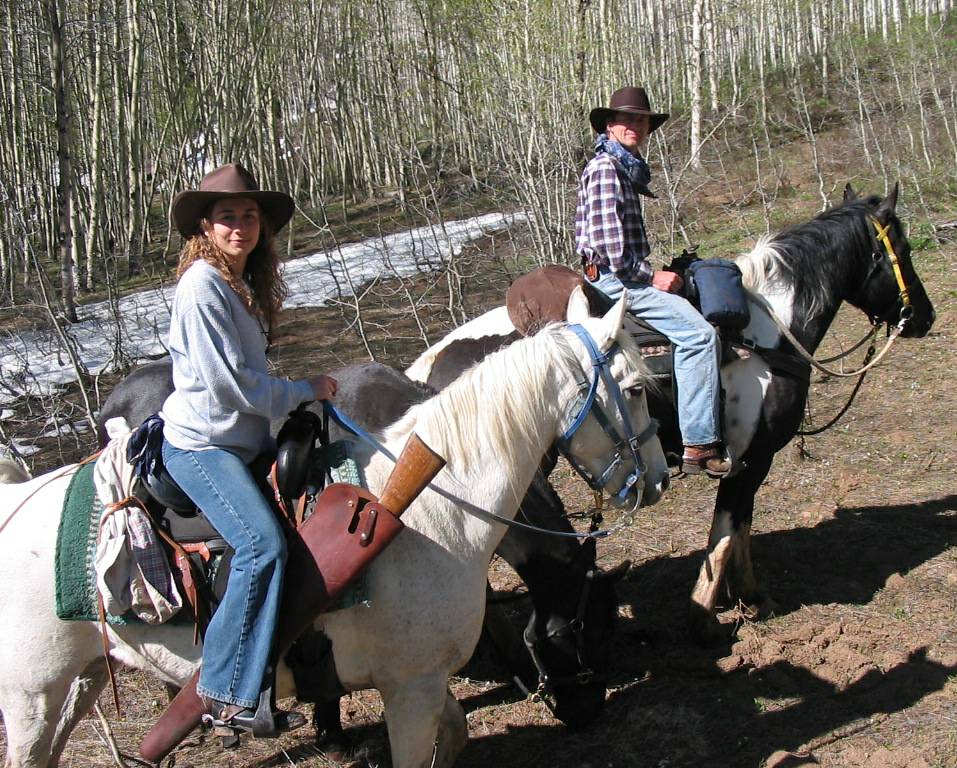
Caity and Brad
I’ve watched as my husband Brad with one of our sons or daughters repaired a car, or saddled the horses for a ride. There’s something special in that. There’s a shared feeling of accomplishment and triumph when they both roll out from under the car with greasy hands, unitedly having solved a problem. Other kinds of problems may be solved, or circumvented in the process, as hands and minds repair, restore, or tune-up a thing of greater value—a relationship. There’s a connection when two set off alone on a moonlight ride. They return with a bit of moon inside of them—a bit of that light that warms and unites two hearts against the darkness.
The same may be true when four hands cook or bake side-by-side together, creating a culinary masterpiece or a simple peanut butter sandwich. It doesn’t matter what it is, it’s in the doing together that the bond is created.
Daddy McKay Piano
My father with our granddaughter–his great-         granddaughter–where else, but at the piano.
There are other valuable duets: mentor and apprentice, hero and sidekick, teacher and student, peer and peer, friend and friend, parent and child, sister and brother, grandparent and grandchild, husband and wife.
791e53a6f9538f871bd500b771285bd7
 One of the most rewarding duets outside of family relationships is when two work together to serve another. Four hands lifting and assisting someone in need, or lifting and serving each other. I have witnessed the power of this duet. It is strong, powerful, and life changing. When two combine their personal gifts and strengths to help another, they develop an unspoken bond. It’s difficult to pinpoint or explain, but I have experienced this, and can tell you that you feel one in purpose and one in heart when you lay aside other plans, and together with another like-minded person, give your time and energy to serve someone in need. You don’t even have to know the person with whom you serve prior to the moment of service. When you are finished, you see them through a familiar lens of understanding and compassion. You are like them and they like you—linked together in a uniquely special way. Four hands, two hearts, one mind.
It is not my purpose to lessen the value of trios, quartets, or other numerical combinations of people gathered for a unified experience. Not at all. Having participated in trios, quartets, double-quartets, and choirs composed of hundreds of souls, I can attest to the fact that there is a shared and harmonious unity in those experiences—even an unparalleled thrill to be part of such a group effort.
20150506_160255
Me at the piano as a teenager–many eons ago.
Playing solo also has its place and benefits. It can provide lessons of courage and accomplishment, and boost self-confidence. Spending hours alone at the piano, alone with one’s thoughts, and the beautiful and inspiring music created is therapeutic.  Pounding out frustration and thinking things through are endeavors worked out on piano keys or through music throughout the ages. All of these are productive, purposeful, and enjoyable.
Amanda and Grandma playing the piano together, 1997?
Some of the family enjoying a duet.
But when there’s only one, there’s no one else to share the thrill and joy of the experience. When alone, one’s focus tends to center on self—one’s vision narrows. One—a single entity—benefits from another who can provide balance and communion. With two, the focus shifts to the other. What is the other feeling? Will I be able to tune myself to his or her mind and heart? Will we be able to connect and create a thing harmonious and beautiful?
05439dba1123856ac17ffec10ac36b19
When we du-et, (do it) it’s magical!
End Piece
© May 6, 2015
From the bottom of my heart, I thank you, dear friends, for reading.


Thursday, July 31, 2014

"Bridges"

Blog Post #15


bridge1
brij/
noun
noun: bridge; plural noun: bridges

1.    a structure carrying a road, path, railroad, or canal across a river, ravine, road, railroad, or other obstacle.
"a bridge across the river"


·       something that is intended to reconcile or form a connection between two things.


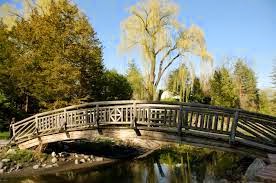
The other day, I passed a house that had a cute little footbridge spanning a faux rock creek bed in the front yard. After stopping to admire the scene for several seconds, I continued my errand, all the while wondering why the addition of the little wooden bridge made the scene so engaging, and if I would have even noticed that yard without it.


I think quaint, old, weathered bridges of wood or stone are charming and picturesque. Beginning in childhood, if I came upon a bridge—even if it was merely a flat slab of stone laid across a muddy flow mixed with rain-gutter run-off—I felt almost compelled to cross it, (provided it was wide enough for a generally klutzy person such as I to maneuver across without losing my balance and tumble into the mire). Let me note that a narrow, fallen log traversing a coursing river five or six feet above the waterflow does not have the same effect on my psyche. I am more inclined to take a picture of my wildly coordinated husband and children in such a scene than race to cross it myself.)
 
Narrow, & slippery with moss: Unsafe.

Wide, with railing: Safe.

Still, any footbridge that looks relatively safe calls to me, and I will go out of my way to cross it. If not to cross it, then to stand on it, leaning delicately on the railing, daydreaming and feeling picturesque myself—like a willowy fairytale figure who had lightly skipped to the rail, lingering there before flitting off, butterfly-like. (Then, someone really does snap a picture. When I see it, there is immediate shock and dismay. The picture my imagination took was, by far, more enchanting and attractive than the real thing. Instead of a graceful nymph bathed in soft, glowing light sprinkled with magical pixie dust, there—in the harsh reality of day—is the image of a frizzy-haired, T-shirted housewife leaning ponderously on the railing, as if every ounce of energy spent plodding along to the bridge had been exhausted, and its sole purpose was to bear her up.)


Bridge scene from "The Lord of the Rings": Arwen and Aragorn


Nevertheless, being on a bridge transforms me inside. There’s something mesmerizing about standing on a bridge watching the water gently pass beneath, with its floating cargo of leaf boats and twig sprites frolicking blithely along.  


There’s something emotionally stirring about bridges. Moviemakers apparently think so. How many scenes of a romantic, tense, or threatening nature culminate on a bridge? (The Bridge Over the River Kwai, Anna and the King, The Music Man, It’s a Wonderful Life, Sabrina, Gone with the Wind, The Lord of the Rings, and The Bridge to Terabithia are just a few with moving scenes that occur on a bridge.)
 
Jimmy Stewart as George Bailey in "It's a Wonderful Life"


Bridges have also inspired many songs. What child hasn’t heard the 17th century nursery rhyme about the ill-fated London Bridge? Everyone who lived in the late 1960s knew the fictional Billie Joe McAllister jumped off the Tallahatchie Bridge (Ode to Billie Joe by Bobbie Gentry), while Simon & Garfunkel’s Bridge Over Troubled Water moved listeners with the power of friendship.

Ancient London Bridge

A bridge, in very name, is more than a physical structure. It is a symbolic manifestation of its purpose. Maybe that’s the reason for my connection with bridges. Because they connect. They bridge gaps, overcome obstacles, link together, span chasms, and simplify journeys. Life is replete with obstacles—both physical and emotional. We step to the edge, and hope for a bridge to help us across. Sometimes, we wade in the muck before a large flat stone appears that provides a means of stepping up, and out.


I find it interesting that an arch bridge has no structural integrity until the stones meet in the middle at the keystone. It’s in the meeting of the two sides that gives the bridge its strength. Because placing the keystone can be a tricky business, scaffolding or other means of support are required to aid in construction. Once in place, an arched bridge needs no mortar to hold it together, and may stand for millennia.
 

Arkadiko Bridge, Greece - oldest standing arch bridge


Ca. 1300-1190 BC


So true of people, too.  Once the keystone of a relationship is in place, it can stand the test of time. Obstacles of differing viewpoints, backgrounds, and habits flow like water under the bridge when people have struggled through building the abutments of a relationship and recognize the inherent keystone of worth in each other. In forming a bridge with someone, we bear one another’s burdens, we meet eye-to-eye, we understand through experience, we withstand tension, we create an equally firm and binding yoke that provides safe passage. Those relationships take on the substantial, but charming quality of a quaint old bridge: pleasing, aged, tried, solid, and true. Clinging, trailing vines of laughter, endurance, thoughtfulness, and kindness adorn and beautify life’s bridges, adding a cheering, optimistic aspect.


I suppose the bridge, the brook, and the flora and fauna might have been viewed from the riverbank. They make a pretty scene from any angle. However, I prefer to step on the bridge, to linger there, and to, eventually, cross over. Crossing to the other side to see from all angles makes the experience complete. 


© Copyright July 31, 2014


Saturday, June 7, 2014

A Beautiful Mess

Blog Post #8


Enchanted trees.... 

That’s how I think of Jacarandas. They sprinkle fairy dust underneath their canopied branches of lavender blossoms. On streets lined with Jacaranda, rivers of purple flood the curbs reflecting the swaying limbs above. I love Jacarandas! I look forward to each May and June, when they’re at the height of their enchanting color, their exquisite beauty, and their—what was that? Did I hear someone say, “Mess?”

More than one person who has a Jacaranda tree has told me how much they hate them and the mess they make. But they’re so beautiful, I protest. These people are beyond enjoying their beauty. All they can see is the mess that follows the delicate display of their lithe, trumpet-like flowers. Lavender petals that fade and dry and moosh and get tracked onto the carpet and make it hard to clean up the yard. Pretty soon, I’m told, they wither and even become ugly.


Here’s a truth: messes and beauty go together; they walk hand-in-hand—opposites that not only attract, but also cooperate. Beauty is almost dependent on a mess. Before I have a beautiful jar of peach preserves, I have a kitchen full of bottles, pots and ladles, sugar granules on countertops, paring knives, bowls of pits and slimy peels, and sticky stuff just about everywhere. A real mess. But have you ever stopped to admire a jar (better yet, a dozen jars) of freshly bottled peaches? Beauty. Simple beauty. I make a practice of leaving jars of freshly preserved jams and fruit sitting in neatly ordered ranks and files on the table for  a day or two where I can admire them each time I pass by. They make me happy. They radiate beauty born of months of growth, harvest, honest toil, and…a mess.


So many messy situations culminate in beauty: creating a work of art, reorganizing a closet, sewing a new dress, preparing for and planting a garden, a haircut, making a Thanksgiving feast. Probably the most rewarding of messy situations are labor pains.


I can’t think of anything more beautiful than a baby.  But even a brand new baby has to be cleaned up at birth—and frequently thereafter; one continuous series of messes coming out of every end. Not to mention the state of the house as the baby grows. Constant upheaval and disarray. Stacks of laundry. Piles of dishes. Toys. Books. Pots and pans. All pulled from their places and scattered abroad like seaweed on the beach.

As children grow, they become expert at making messes: grimy fingerprints on mirrors, windows, doors and walls; bedrooms that look like a Goodwill drop-off; sand and dirt on freshly mopped floors; backpacks and shoes cluttering the entryway; and socks—endless smelly socks—emerging from every nook and cranny you didn’t know existed.


It’s all worth the beauty that attends the mess: crayoned pictures laden with hearts—drawn and given by the stacks; hugs and wet kisses; holding a tiny, trusting hand; the words “I love you, Mom” scraped into the dirt on the hill in the backyard….there’s nothing like it for the price of a mess. Nothing.  

My mother appreciated a good mess. She understood that messes were companions to creative beauty. She urged us to make messes and praised the beauty—or attempts at beauty—we created. She gave us (almost) free range of the house in which to make our messes.  She also taught us to clean, and somehow managed to have a clean house underneath the messes we made.


I recall the day I discovered that we did indeed make messes. (Frankly, before that day, I hadn’t noticed.) That day of enlightenment came when I was only about….oh, fourteen. (Not kidding.) My mother had a calligraphy project going at her drafting table at one end of the family room. I was busily mass-producing pictures to sell that required tedious cutting of burlap, fabric scraps and construction paper, as well as gluing and the use of markers at a card table set up on the other end of the family room. My sister was also occupied with a project of her own in the same room. (Heaven only knows where Craig was at the time. Probably making an entirely private mess of his own in his room.)

The doorbell rang. A friend was at the door. My friend. What’s worse, the friend happened to be a boy I liked. Someone I never expected to come to our house….ever! When I first opened the door, I was oblivious to the mess. When my friend walked in, I saw THE MESS in all Its Terribleness. I tried to stand in front of the card table to block, at the very least, my mess from view, but to no avail. My small frame was no match for the sheer quantity of MESS splattered across every square inch of that room screaming the words “Look at me!” like a flashing neon sign.

It turned out OK in the end. The friend left after a brief and, for my part, extremely uncomfortable few minutes. He surely had an eyeful of what went on in our house. But we continued to make messes, and we enjoyed the beauty we created. The real beauty, however, was in the time we spent, and the love that grew from making the messes together.


The beauty of Jacaranda trees comes before the mess they make, but the order really doesn’t matter. Shedding their flowers is so important to the production of fruit, seeds, and growth. It’s a necessary step toward an encore display of their magical fairy dust in years that follow. As I see it, what does matter is that they first give something splendidly beautiful to the world before casting their refuse on the ground, (which, by the way, still looks magical when it first falls). It is part of an important cycle. They make the most of their few moments to sparkle, knowing what will come.


Maybe that’s why messes are important to life: to help us better appreciate and recognize the beauty in special moments. Messes also help us see order in creation and throughout life. A mess can have elements of order to it, it can be part of a greater plan—as with the peach preserves. It may look a mess to the untrained eye, but there is order in the kitchen chaos working toward a planned goal. I always clean up after (sometimes during) a messy situation: an important lesson accompanying messes. The “cleaning up” lesson, if never learned, creates its own mess!


Surely, the cycle of mess and beauty is true of people. Our lives may seem a mess at times, but as we work through the chaos, we become more complete, strong and beautiful people—beautiful as to character, opposed to looks—better able to cast aside the refuse—those things that hold us back—and move forward, producing seeds of growth that contribute to a fulfilling and joyful future.


So, here’s to messes! And may our messes create as much beauty as the Jacaranda!


© Copyright June 7, 2014