Tuesday, June 10, 2014

"The Lizard Whisperer"

Blog Post #9 (A True Tale)


My husband Brad is “The Lizard Whisperer.” That’s right. Lizard. Whisperer.

Living here at my father’s house, Brad hasn’t been able to have his preferred menagerie: dog, cat, horse…. so he has settled for the next best thing: whatever there is.  He made and mounted wooden feeders for the squirrels on the block wall surrounding the yard, and hung sugar water for the hummingbirds. Although he isn't crazy about the *mockingbird that sings outside our bedroom window while we're trying to sleep, he would welcome its companionship and musical medley the rest of the day. I'm grateful he hasn't chosen to befriend other critters that have happened into our yard: opossums, skunks and a hive of bees. He is interested in them, however, watching and studying their behavior.

Brad is nature’s son, loving and respecting animals and nature. He’s the kind of guy that turns over rocks to see what’s underneath, feeds and waters the horses before eating his own breakfast, and takes a whole roll of film of his Golden Retriever posing in El Dorado Canyon, Colorado.  He saves every drop of water, and is expert at making campfires under a tree in the snow. I love and admire all these things about him, partly because they are what I am not.

Brad's dog, Kona, posing in El Dorado Canyon, Colorado

Another picture of Kona in El Dorado Canyon
(Imagine how many pictures he might have taken if he owned a digital camera at that time)


Brad is also one of the most resourceful people I’ve ever met. And frugal.  He doesn’t waste anything. If he finds something lying around, he’ll put it to good use in a way nature didn’t intend. It seems reasonable, then, that when he found lizards lying around, —which is what they do—he put them to use in a way nature didn’t intend.  

I realize many people keep lizards and other reptiles as pets. Brad doesn’t bring them in the house. (Just let him try it!) Nor does he keep them in a cage or case. He hates seeing dogs on leashes, and horses tethered (unless he's riding one). With liberty and justice for all lizards, they roam our yard, emerging from their hiding places between the shed and the block wall, from holes between rocks and from under the barbecue to sun themselves on the pavement. But they pledge their allegiance to our yard--all because of The Lizard Whisperer.
 
A favorite hiding place of our lizards

Our lizards are quite normal. As is common, they like to show-off their strength and dexterity by doing two thousand push-ups at a time on the block wall. When the grandchildren attempt to catch them, they demonstrate their quick reflexes and speed, by darting off on their short little legs, faster than speeding bullets, like grounded Supermen—capes flowing in the breeze.

Exceptionally normal lizards, really. Except for one thing: The Lizard Whisperer.
 
Ready or not, you shall NOT be caught!

Brad has spent hours doing yard work, cleaning-up and restoring Daddy’s yard to some of its former utility and beauty, and tending our vegetable garden. He has spent a lot of time observing, (and being observed by) the lizards.  They’re curious, and suspicious, creeping out from their hiding places, always warily keeping their distance, as if they weren’t sure they heard IT call out “Olly Olly Oxen Free!” Like fleet-footed scouts, they zip away with lightning speed if startled.


Garden where the lizards and T.L.W. often meet

Methodically, Brad began testing the lizards. Finding small bugs he knew looked like thick juicy steaks to the lizard watching a few feet away, he set the tiny wiggling insect a small distance off to see if a lizard would take the bait. Gradually, he moved the bait farther away from the lizards, discovering their Superman speed is only rivaled by their remarkable eyesight. From great distances, they raced like sleek tailed-dragsters to beat other lizards to the free eats.

Not only were the lizards watching Brad, but so was I. One day I noticed him scouting around the wall and shed area. His movements were a little odd, so I asked the obvious: “What are you doing?” Nothing. (He was focused on what he was doing.)  After a few minutes, I gave up and went inside, but watched from the window. He crouched down, waiting. He is good at waiting. I’m not; I stopped watching.


One day he told me he was going to ride his bike to the new sporting goods store around the corner. He’s an umpire, so I thought he might check out the baseball gear. After he got home, a new little white plastic container appeared, first on the dryer in the garage, and later in the fridge. “What’s that?”  Nothing.  Later, I reached for a tub of margarine from the fridge. “Not margarine. Mealworms!”  I’m onto him now! He’s been purchasing mealyworms to feed the lizards! The small white container the store provided must not have been large enough, so the mealworms graduated to a roomier margarine tub, and to an air conditioned place in the fridge. (This was either for Brad's convenience, or for the comfort of the mealworms. Not sure which.) 
What I found in the fridge

Mealworms....Yum
What next? I’ll tell you…

He’s kneeling down, arm outstretched, hand open on the ground. Something small and wiggly on his palm. Yoga position?  No. A lizard is standing on the pavement about four or five feet off. He’s having a stare-down with Brad.  The mealworm’s destiny lies in the balance. Lizzy creeps closer, keeping a weather eye out for danger. Keeps creeping. He’s in Brad’s hand. Grabs the worm and takes off. Score!

History repeats itself, but this time the lizard comes from the block wall. Brad's hand outstretched, waiting. 

Ready.

Set.

Go!


Word gets out through the lizard grapevine. Other lizards line up for the dole. (I don’t know how they pass the word, but I’m sure they do.) They’re eating out of his hand, some nibbling at his toes. A lizard in hand is worth two behind the shed.
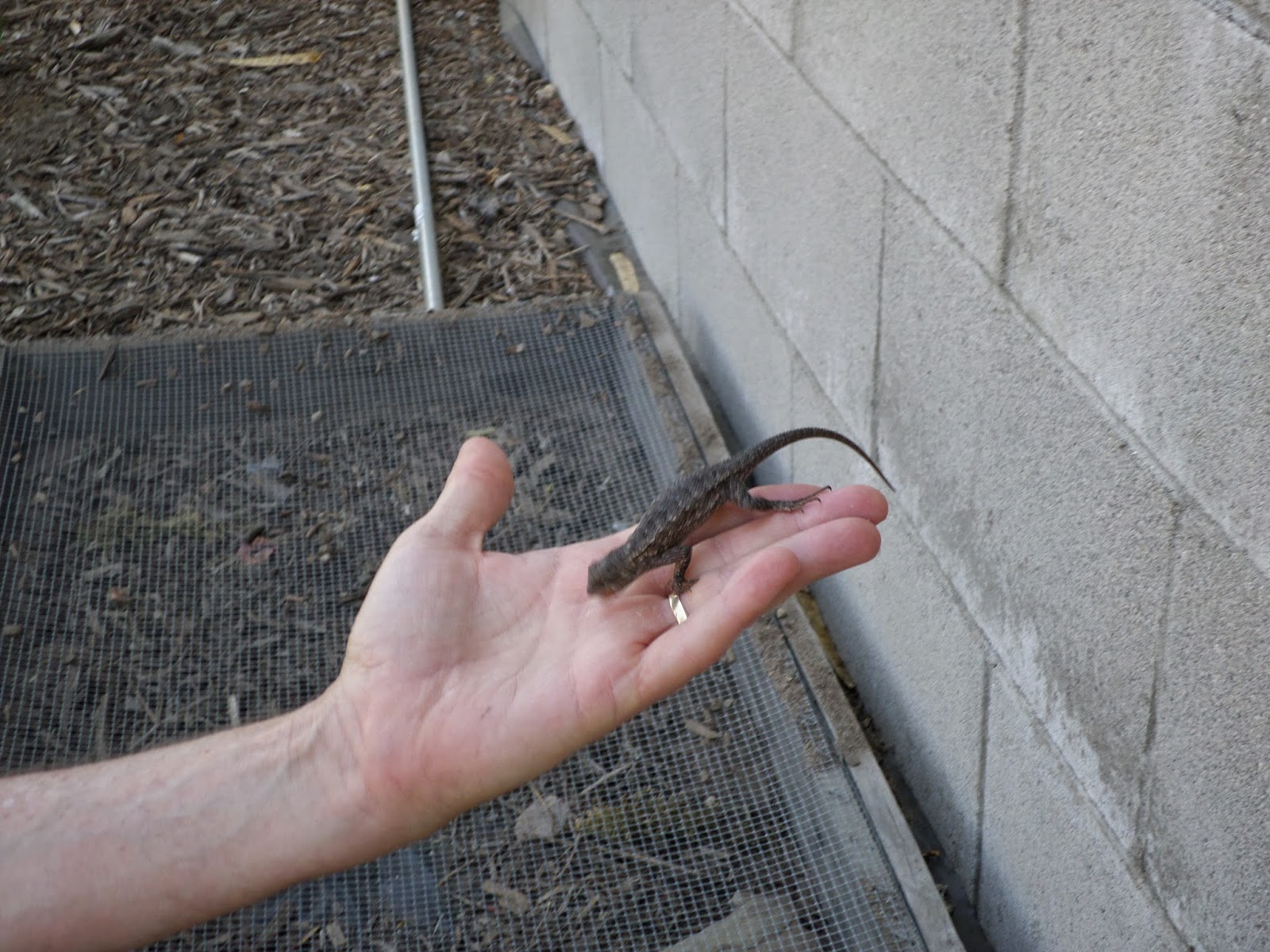


One day, Brad was walking around the shed, scrutinizing the side near the wall with particular interest. “What are you doing?” Nothing. I stayed, waiting. Suddenly, like a Close Encounter of the Lizard Kind, one by one, half-a-dozen lizards appeared out of the darkness cast by the shed’s shadow on the block wall. Others came from the holes in the top blocks along the wall to the right. Brad waited, arm outstretched, mealy worms in his open palm close to the wall. Soon, lizards were jumping off the wall into his hand, grabbing a worm, and jumping back onto the wall again, taking turns getting the worms. Two worms each, Brad kept track.  Amazing!
 
Brad tempting lizards with plump, juicy mealworms.
You can see them coming out from behind the shed (upper middle of picture).
Since then, most of the lizards in our yard seem to know Brad. They aren’t tentative in the least, openly approaching him for mealworms. Like feeding chickens, he makes his normal rounds after work each day. They are comfortable walking onto his hand to eat: a drive-through cafĂ© for lizards.


Last week, a very plump, familiar lizard was lying on the sidewalk near the back door. Too many mealy worms, I thought. Later that day, Brad asked if I saw the pregnant lizard. (Yup. That was her.) Poor thing. She looked as if she had swallowed a small mouse. Not long after, she was fit and thin again. Her clutch of eggs must be hidden somewhere nearby, and before long, we should have a lounge (appropriately named) of baby Lizzies lounging around waiting for Brad to befriend, coddle and feed them.

I walk out the back door; two hopeful lizards are waiting there—like miniature furless, long-tailed puppies, anxious for me to pet and feed them. I’m not the one they want. I’m only his wife. But those little guys know the hand that feeds them: The Lizard Whisperer.

Western Fence Lizard (or Spiny Lizard)
Sceloporus occidentalis

For a split second, I see through their lizard eyes: 

The Lizard Whisperer rides off on his white horse into the sunset.

The Lizard Whisperer
(Had a picture of him on the white horse; missed the sunset)


 *See blog post #7 "For the Birds"


© Copyright June 10, 2014


Saturday, June 7, 2014

A Beautiful Mess

Blog Post #8


Enchanted trees.... 

That’s how I think of Jacarandas. They sprinkle fairy dust underneath their canopied branches of lavender blossoms. On streets lined with Jacaranda, rivers of purple flood the curbs reflecting the swaying limbs above. I love Jacarandas! I look forward to each May and June, when they’re at the height of their enchanting color, their exquisite beauty, and their—what was that? Did I hear someone say, “Mess?”

More than one person who has a Jacaranda tree has told me how much they hate them and the mess they make. But they’re so beautiful, I protest. These people are beyond enjoying their beauty. All they can see is the mess that follows the delicate display of their lithe, trumpet-like flowers. Lavender petals that fade and dry and moosh and get tracked onto the carpet and make it hard to clean up the yard. Pretty soon, I’m told, they wither and even become ugly.


Here’s a truth: messes and beauty go together; they walk hand-in-hand—opposites that not only attract, but also cooperate. Beauty is almost dependent on a mess. Before I have a beautiful jar of peach preserves, I have a kitchen full of bottles, pots and ladles, sugar granules on countertops, paring knives, bowls of pits and slimy peels, and sticky stuff just about everywhere. A real mess. But have you ever stopped to admire a jar (better yet, a dozen jars) of freshly bottled peaches? Beauty. Simple beauty. I make a practice of leaving jars of freshly preserved jams and fruit sitting in neatly ordered ranks and files on the table for  a day or two where I can admire them each time I pass by. They make me happy. They radiate beauty born of months of growth, harvest, honest toil, and…a mess.


So many messy situations culminate in beauty: creating a work of art, reorganizing a closet, sewing a new dress, preparing for and planting a garden, a haircut, making a Thanksgiving feast. Probably the most rewarding of messy situations are labor pains.


I can’t think of anything more beautiful than a baby.  But even a brand new baby has to be cleaned up at birth—and frequently thereafter; one continuous series of messes coming out of every end. Not to mention the state of the house as the baby grows. Constant upheaval and disarray. Stacks of laundry. Piles of dishes. Toys. Books. Pots and pans. All pulled from their places and scattered abroad like seaweed on the beach.

As children grow, they become expert at making messes: grimy fingerprints on mirrors, windows, doors and walls; bedrooms that look like a Goodwill drop-off; sand and dirt on freshly mopped floors; backpacks and shoes cluttering the entryway; and socks—endless smelly socks—emerging from every nook and cranny you didn’t know existed.


It’s all worth the beauty that attends the mess: crayoned pictures laden with hearts—drawn and given by the stacks; hugs and wet kisses; holding a tiny, trusting hand; the words “I love you, Mom” scraped into the dirt on the hill in the backyard….there’s nothing like it for the price of a mess. Nothing.  

My mother appreciated a good mess. She understood that messes were companions to creative beauty. She urged us to make messes and praised the beauty—or attempts at beauty—we created. She gave us (almost) free range of the house in which to make our messes.  She also taught us to clean, and somehow managed to have a clean house underneath the messes we made.


I recall the day I discovered that we did indeed make messes. (Frankly, before that day, I hadn’t noticed.) That day of enlightenment came when I was only about….oh, fourteen. (Not kidding.) My mother had a calligraphy project going at her drafting table at one end of the family room. I was busily mass-producing pictures to sell that required tedious cutting of burlap, fabric scraps and construction paper, as well as gluing and the use of markers at a card table set up on the other end of the family room. My sister was also occupied with a project of her own in the same room. (Heaven only knows where Craig was at the time. Probably making an entirely private mess of his own in his room.)

The doorbell rang. A friend was at the door. My friend. What’s worse, the friend happened to be a boy I liked. Someone I never expected to come to our house….ever! When I first opened the door, I was oblivious to the mess. When my friend walked in, I saw THE MESS in all Its Terribleness. I tried to stand in front of the card table to block, at the very least, my mess from view, but to no avail. My small frame was no match for the sheer quantity of MESS splattered across every square inch of that room screaming the words “Look at me!” like a flashing neon sign.

It turned out OK in the end. The friend left after a brief and, for my part, extremely uncomfortable few minutes. He surely had an eyeful of what went on in our house. But we continued to make messes, and we enjoyed the beauty we created. The real beauty, however, was in the time we spent, and the love that grew from making the messes together.


The beauty of Jacaranda trees comes before the mess they make, but the order really doesn’t matter. Shedding their flowers is so important to the production of fruit, seeds, and growth. It’s a necessary step toward an encore display of their magical fairy dust in years that follow. As I see it, what does matter is that they first give something splendidly beautiful to the world before casting their refuse on the ground, (which, by the way, still looks magical when it first falls). It is part of an important cycle. They make the most of their few moments to sparkle, knowing what will come.


Maybe that’s why messes are important to life: to help us better appreciate and recognize the beauty in special moments. Messes also help us see order in creation and throughout life. A mess can have elements of order to it, it can be part of a greater plan—as with the peach preserves. It may look a mess to the untrained eye, but there is order in the kitchen chaos working toward a planned goal. I always clean up after (sometimes during) a messy situation: an important lesson accompanying messes. The “cleaning up” lesson, if never learned, creates its own mess!


Surely, the cycle of mess and beauty is true of people. Our lives may seem a mess at times, but as we work through the chaos, we become more complete, strong and beautiful people—beautiful as to character, opposed to looks—better able to cast aside the refuse—those things that hold us back—and move forward, producing seeds of growth that contribute to a fulfilling and joyful future.


So, here’s to messes! And may our messes create as much beauty as the Jacaranda!


© Copyright June 7, 2014


Tuesday, May 27, 2014

For the Birds

Blog Post #7


As long as I can remember, I have awakened to a concert of birdsong, which has mostly been taken for granted. Gradually, my mind has awakened from an oblivious stupor, and taken notice, realizing how much their trills and whistles are a part of my life—how devoid of joy the rustle of leaves in the breeze would seem without the accent of their sweet music.   

Mourning Dove


The first welcome greeting of the day is always the low and melancholy cooing of the mourning dove. Aptly named, her subtle tones, soft and sad, transport me to a time long gone—a time lost to time—the time of my youth. As I listen, I am sixteen again—up early, the window slightly ajar, listening—the dove reminding me that each day is like the next. Nothing will change. But everything does.  I am not a child anymore. My nest, once full, is now empty. I stand where my sixteen-year-old self stood, by the same open window, listening. The dove is still there—ageless. I can’t imagine beginning a day without her gentle warblings. So accustomed to her soothing tones am I, that they speak comfort and peace to my heart, and pledge a vow of constancy amid the inevitability of change. How ironic that the dove—the symbolic bird of peace—bodes both loss and comfort.


One tweet leads to another…. Another bird song comes to mind, one that disappeared with the passage of time, as the neighborhood grew and developed. The elusive singers of the abrupt and scratchy ballpark cry of Chi-ca-go! Chi-ca-go! were most often heard and not seen. 

California Quail

When leaving for elementary school early in the morning, sometimes I had the rare treat of meeting a family of quail in front of our house. I whispered a greeting to the little family, but the mother scurried off with her little covey of four or five chicks, their curled plumes pointing the way as they swiftly followed on quick, tiny feet to find cover in the large pine and gazanias that once occupied the west side of the driveway.


As a child, I was less fond of the ominous, scavenging crows—always watching from their perch on the power lines—peering out of those beady black eyes, ready to swoop down for carrion and crumbs as they cawed their warning cry. Now, I think of them as old pals, still watching from a distance, but in a friendlier way.


Crows

 After decades away, we have returned to my childhood home to care for my aging father. The birds are still here—same ones, and some less familiar to me. My husband has become particularly annoyed with a mockingbird that lives up to its reputation, for mock he does! He purposely made his home outside our bedroom window, and like a long-running Broadway musical repeatedly performs his repertoire of calls with show time beginning at five o’clock every morning. I think he does it just because he knows how much it irritates Brad, who has always been a light sleeper.
 
Mockingbird

A favorite of mine is the meadowlark. His cheerful, melodic song beckons me outdoors, “Open the window!” he says. “Come outside, and enjoy the sunshine! Be happy! It’s a beautiful new day!” And when I do, I’m not disappointed.


Brad takes care of our tiny friends, the hummingbirds, inviting them to sip sweet nectar outside our windows so we can enjoy their aerial antics and their beauty. The only sound I’ve ever heard from them is the bee-like buzzing of their wings, as they zoom like flying aces in and around the feeder with their sword-beaks drawn to defend their territorial rights. Their iridescently colored vests flash like brilliantly painted shields in the sun.
 
Hummingbird

Not long after we moved back to my father’s home, I heard a loud squawking coming from the trees out front. Unfamiliar with the sound, I rushed out to see what it was. Brilliant flashes of chartreuse and vermillion perched on limbs and branches and fluttered from tree to tree. Hundreds of wild Yellow Head Amazon parrots decorated the silk and pepper trees in our front yard like tropical Christmas tree ornaments. The “Pasadena Parrots,” purportedly escaping fire in a bird shop in the 1950s or 60s, have developed a following in Southern California, as they move from town to town parading their vibrant plumage and filling the air with their dissonant tones. 

Amazon Yellow Head Parrot

The contrast between these new and transient feathered neighbors and the settled presence of the doves, mockingbirds and crows punctuate the current dynamics of our neighborhood.

Over the fifty-plus years since my parents purchased their dream home, we’ve seen all our neighbors either move away, or pass away. At ninety-one, my father is the last original owner on the street. Changes in lifestyle have also affected our neighborhood. With the exception of the dog-walkers and school kids, we see but little of our neighbors. So many pull out of their garages in the morning, and pull back into them at night. We wave, and peer at them from a distance like the crows on the line, wondering if we can snatch a morsel of friendship before one or the other of us swoops away again.


Many neighbors are shy and anxious acquaintances—wary, like the quail—sharing a parcel of earth for a short time, until they up and leave without a good-bye.

Others, like the hummingbirds, we see speed up and down the street on brightly colored "wings." They’re in too much of a hurry for conversation; the only noticeable sound is the humming of their engines as they disappear down the street and around the corner.

The bright spots in the neighborhood are those who talk to us, and to each other. We see them at work in their yards, then flit from home to home, sharing the bounty of their fruit trees and gardens, and a few cheery words along their way. Like the meadowlark, they understand the meaning of the words “neighbor" and "friend;” they sing songs of joy, encouraging others to “come out into the sun, and enjoy the beautiful day!”


But of all the birds, the doves have nested in my heart. They soothe me with their motherly lullabies each morning, calming me with a sense of security and constancy, and assuring me that some things remain the same in an ever-changing world.


© Copyright May 27, 2014


Thursday, May 15, 2014

“In Defense of Worthy Words “

Blog Post #6 (Soapbox)

Illumination

 “Refinement in speech is more than polished elocution. It results from purity of thought and sincerity of expression. A child’s prayer on occasion may reflect the language of heaven more nearly than a Shakespearean soliloquy.”  - Douglas L. Callister https://www.lds.org/ensign/2009/06/our-refined-heavenly-home?lang=eng


I love beautiful words. I love to hear words eloquently spoken. I love to read powerful and illuminating words. I love words of truth. I love words that inspire a wellspring of goodness, virtue and light.  


I know a man—a very scholarly man—whose speech is that of a farm boy. Yet this humble, quiet man speaks with power and authority. He isn’t loud or bombastic. He doesn’t sound practiced in oratory skills. His words are born of years of sacrifice, intense study, and a commitment to principles of integrity. The words that flow from his mouth are deep, sincere, quiet, simple, and ring with truth that resonates in the deepest fibers of the soul.

This post is in defense of worthy words,—not ostentatious, redundant, or vulgar words—but words that cheer, uplift and enlighten. A farm boy’s drawling speech is of far greater worth than that of a hundred skillful orators if his words transcend theirs in wisdom and truth.


Of all sad words of tongue or pen, the saddest are these, 
'It might have been.”  
― John Greenleaf WhittierMaud Muller - Pamphlet


“She had always wanted words, she loved them; grew up on them. 
Words gave her clarity, brought reason, shape.” 
― Michael OndaatjeThe English Patient


  “We live and breathe words.” ― Cassandra ClareClockwork Prince


Words are important. They can alter relationships. They can bind hearts. Words are in and through every part of life. They Challenge, Inspire, Uplift, Depress, Weary, Strengthen, Appease, and Unite. Words begin and end wars.

Words are the beats in the metronome of language. When arranged in various phrases, with varying punctuation, the same words can mean completely different things, having completely different *effects.

Look at how words have shaped art, philosophy, emotion, and action: think Shakespeare and the scriptural language of Tyndale, think music lyrics and poetry, think Lincoln, Emerson, Wordsworth, and a host of others.


I’ve never understood why there are learned people who choose to pollute and dilute their communications—particularly the written word—with unworthy words. I am always especially surprised to hear and read swear words coming from a teacher, just as I'm often astonished to find a singer smoking. It's baffling to me. It's paradoxical. Why do they choose to do it?

A teacher, by virtue of his or her position instructing and correcting others, might at least attempt to articulate the most accurate and lucid words the English language has to offer. To teach is to model. While it's true that actions speak louder than words, words uttered speak volumes about a person’s character.


Recently, I've noticed Facebook posts by a teacher I knew when I was a student in the public school system many years ago. His remarks sounded intelligent and friendly until he introduced crude and obscene words into some of his posts. At first, I thought it was just a slip of the pen, but I finally decided it was intentional. I no longer read his posts because I never know when these unwelcome surprises will surface. 

I was saddened by this revelation. Disappointed, really. For a man with a cultured persona, I couldn't help but wonder why he would include foul language in his words to the public. He had to make a conscious choice to include obscenities. 

I realize that writing isn’t the same as speaking. When speaking, it’s easier to let inappropriate words slip out unintentionally, especially in emotionally charged situations, or when a habit of swearing already exists. A word sometimes escapes out of the mouth without thought, but unworthy spoken words are never retractable. They are like seeds in the wind, blowing wherever the wind (and people) will carry them, planting  ignoble thoughts in the minds of others.


When writing (as in a Facebook post) it’s so simple to delete or rethink words. Every word is retractable, exchangeable, and erasable. It’s easy to find relevant and appropriate words on the computer with Google and a thesaurus only a click away.
 
Visual Thesaurus for "word"

I guess I hold teachers to a higher standard of communication than the average person. Not because I think they're better than others are, but because they should know better than others do by virtue of their position among those “enlightened by knowledge.” They should value the beauty and utility of language enough to use the most descriptive and accurate words for any given situation. They should respect those they once taught, and those they continue to influence, by holding their torch for the written word a little higher than average.

In my mind, using expletives demonstrates a lack of mastery of the English language. A person who uses expletives and vulgarities to express a wide range of emotions and descriptions reveals a limited vocabulary. Of all people, a teacher should value the example they set when it comes to word usage. After all, words, and word usage form a primary part of their job description. Communicating ideas, concepts, facts, principles and ideals is a high and noble occupation.

Plato, the teacher of Aristotle
from "The School of Athens" by Raphael

Would a professional athlete, such as Michael Jordan, purposely fumble or mishandle the ball on court? Wouldn’t it outrage his adoring fans? Wouldn’t that set him up for ridicule? Wouldn’t he infuriate his employers? I may be wrong, but I doubt he would allow himself to consider doing such a thing. It would be a humiliation to his high personal standards of performance. I think he would always perform to the best within himself. 

Why do we expect less of teachers? They are professionals. They are every bit role models for those in their sphere of influence as athletes are in theirs. Teachers who purposely use foul language show a slovenly contempt for the highest ideals of education they represent. They trample beautiful language under their feet while elevating the weakest, most deplorable form of speech. 


 “If there is anything virtuous, lovely, or of good report or praiseworthy, 
we seek after these things.” 
Joseph Smith13th Article of Faith 

I love beautiful language. I love eloquent speech. I am not eloquent in speaking myself. I often trip over my tongue. I am verbose. I can say nothing in a million words. Perhaps it is better to speak simply—or to remain quiet—than to impugn one's own character, while showing a lack of respect for those around you with unworthy, vulgar and profane language.


I have deep respect for most teachers. I’ve worked among them. I know how many strive to use worthy and appropriate words, and to live a high standard of behavior—“to walk their talk.” In reality, we are all teachers. Someone somewhere is watching us, listening to us, noting our example, and maybe doing and saying as we do. 

I hope my words are always worthy ones.


*See Eats, Shoots & Leaves by Lynne Truss


© Copyright May 15, 2014