Blog Post #10
I first
learned of the Fishbowl Theory many years ago from my brother-in-law Ken.
The reason for Ken’s explanation has been long forgotten, but the concept rang true, and is permanently etched into my psyche.
What is the Fishbowl Theory?
If you Google “The
Fishbowl Theory” you’ll find multiple explanations. Strangely enough, I didn’t
find Ken’s Theory in my Google search. But of all fishbowl theories, Ken’s
makes the most sense to me.
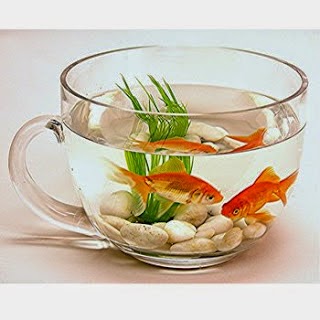
Ken’s Fishbowl
Theory states:
No matter the size of the fishbowl, the fish will use
the whole thing.
Here are a few
simple examples of how people apply the Fishbowl Theory in everyday life:
Dinner
plate in a buffet line - pile it on as if you'll never eat again
Pencil
boxes - I'm sure I can wedge in one more pencil (while another pops out)
Bookshelves - you can never have enough books, stack 'em three rows deep
Car
glove boxes - I've yet to store gloves in a glove compartment; too many out-of-date maps in there
Coffee
tables - lucky to find the table under the stack of mail, books and magazines
Curio
cabinets - which invariably house knickknacks that need dusting—I hate dusting!
Closets - Open door at your own risk!
Refrigerators - remove Tupperware of moldy food to make room for more Tupperware. (At least you don't have to dust what's in the fridge)
Digital
camera memory cards - Always full
Gigabytes of memory
on a phone, notepad or computer - A few years ago, we thought 64 megabytes would be enough. Boy, were we wrong!
Junk drawers - need I say more?
Why do people feel almost obligated to fill, or use up space? As I see it, there’s no apparent Feng Shui satisfaction associated with it, yet if there's a particle of open space, I feel obliged to fill it. Why is that?
Here are two
personal examples illustrating the evolution of the Fishbowl Theory in my own
life:
Example 1 - Purses:
Age
10-12: My first was a small, fluorescent chartreuse-green vinyl shoulder-strap purse
with a buckle (what can I say? It was the 60s) with just enough room in its one
compartment to carry a wallet, a rabbit’s foot (popular in those days), a Troll
doll (also popular), and a pen, pencil and Chapstick. Any cracks in the
congestion were filled with leftover ticket stubs, candy wrappers and Kleenex.
 |
Troll - I had one exactly like the one pictured,
even to the thinning hair. |
Age
13-20: I graduated to a slightly larger leather shoulder-strap bag with a front
flap, and a homemade leather Mickey Mouse keychain (minus the keys) dangling
from the handle. Exchanging the toys for feminine items, I still included
stationery supplies such as pens, pencils, paper, eraser, and anything else
that I could cram into the single compartment. A frantic hunt ensued every time
I needed to rummage for a ring, a loose coin, or an important note on a scrap
of paper buried deep in Never Never-find it-land.
Age 20+:
(This is where the Fishbowl Theory really begins to assert its properties.) At the birth of our first child, in
addition to my regular purse—the same leather bag before mentioned—I acquired a diaper bag of substantial proportions.
The diaper bag had both zippered and open pockets galore, plus several large
divided compartments! I can’t explain the thrill of seeing so many
organizational options available in one bag!

You
never know what you might need with a baby.
A Prepared Mother never has to worry about being caught by surprise. So,
my diaper bag was well stocked with bottles (even though my babies were exclusively
nursed for the first several months), a change of clothes (or three), pacifier,
changing pad, wipes, ointment, powder, stuffed toys, rattles, blankets,
medicine, little squeezy blue bulb syringe, thermometer, baby brush and comb, bathing items, Zwieback toast, a box of rice cereal, bowl, spoon, and a book or two--in case I caught a minute to read.

Must-haves for all diaper bags are diapers; several pre-folded cloth
diapers with pins and plastic pants, as well as plastic bags to carry soiled
(but rinsed) diapers were regularly stocked. (We raised our family just as
paper diapers were hitting the scene. These first attempts at convenience were
sadly inadequate—like a leaky piece of origami—and expensive on a meager budget
such as ours, so we only used them when traveling. In doing so, I only had
twice as many soiled baby clothes to wash due to leaks.)

Back to
the Fishbowl Theory—which I’m sure you’ve forgotten after that lengthy
dissertation on the diaper bag.
The
point? Every square inch of the diaper
bag was used. Why? Because it was there! Would I have crammed so many items
into one bag had it been smaller? Of course not! I would have been more selective.
I might
also mention that this barbell I was carrying around in the name of Motherhood
took its toll on my body. This was
when I began developing what I call “shoulder dents;” a direct result of the
effects of the Fishbowl Theory.
 |
With and without shoulder dents. Had my purse and diaper bag been lighter,
I might have avoided this malady later in life. |
One
day, Karen and I made a trip to Disneyland with our two-year-olds and and an infant in tow. We took one double-stroller
between us. Hanging on the back of the stroller were two identical diaper
bags—gifts from our mother—stuffed to within an inch of explosion, and each
weighing close to 25 pounds (exceeding the weight of each individual child by
several pounds). When a child was lifted from the front seat, the stroller
reared like a tormented stallion, giving the child in the back seat an E-Ticket
ride upstaging any rides of equal ticket value in the park.
 |
Double Stroller (identical to the one we had)
|
|
Fishbowl Theory Lesson Learned Regarding Purses and
Diaper Bags: Go for
smaller, and lightweight. You’ll live longer, and so will your children.
Example 2 – Homes:
When Brad
and I were leaving on our honeymoon from my family home in California to our new home together in Utah, I fit all my worldly belongings into the back seat and trunk of our 1972
gold Dodge Coronet. Five large items formed the bulwark around which everything
else had to be situated for the trip. These
treasured items included:
-
A 1951 Singer
Sewing machine with built-in cabinet (purchased used for $35 to sew my wedding
gown)
-
A 5-string
banjo in its case (Sears Catalog model--still have)
-
A whimsical
vertical bookshelf made of wood by my grandfather (still have, in use by my daughter's family
-
A large
gilt-framed mirror made by my father (still have and use)
-
My
mother’s old wooden drafting table (on which my laptop is currently resting as
I write this post)
 |
Singer Sewing Machine like the one I had
|
All the
smaller stuff was wedged, crammed, and smashed into the empty spaces around
these items with the precision and neatness of fitting rocks puzzle-like into a
cave of spikes. (Fortunately, those old cars were spacious inside, and had
large trunks.)
 |
| 1972 Dodge Coronet |
Brad
carried me over the threshold into a cute little white house at the end of a
long drive lined with lawn, pine and fir trees, lilacs, hydrangeas, and pussy willows. In those
days, I was blissfully unaware of a sense of square footage, (and of the Fishbowl
Theory lurking in my future). It simply didn’t matter to me whether the house
was a shoebox or a palace, so long as it was home. *“I Got Plenty ‘O Nuttin’”
could well have been our theme song in those days.
 |
| Our Little White House |
Brad
procured an old-fashioned rocking chair for my wedding gift—the sole piece of furniture in the living room when I arrived. The kitchen was right out
of a fairy tale—diminutive and adorable—complete with an oven that smoked and long,
screen-less windows that, when unlatched, pushed open, allowing me to toss
breadcrumbs to the birds without stepping outside. Brad’s folks donated an old
dinette table that doubled as counter-top space. There were two small bedrooms,
one tiny bath, and a storage/laundry room, sans washer and dryer. Brad’s double
bed and dresser were our main pieces of furniture. Especially quaint was the
attic, which required scaling a ladder that was propped against the back wall.
A small door opened into a dark, peaked crawlspace where we eventually stored
all superfluous items that we later accumulated. It was a little bit of heaven
at $125/month.
It
wasn’t long before we accrued other “used” (or in today’s vernacular
“pre-owned”) furnishings, including bookshelves, a very long coffee table, and a
borrowed piano, as well as the ugliest and hardest couch in existence. (To
makes things worse, the couch folded down into a double bed of stone.)
 |
| Storage attic and ladder |
We
stored wheat, and other food items for emergencies, and purchased a large Ozark
Mill to grind the wheat for bread. The mill took up roughly half the square
footage of the kitchen, and, during operation, made (and continues to make)
enough racket to wake the dead.
 |
| Ozark Wheat Mill |
We also
acquired a plethora of baby items: a bassinet, a crib, and a huge baby buggy (I
include it with the furniture because it was in the only room large enough to
store it—the living room—and rivaled the couch in size. It sailed smoothly on
dirt or sidewalk, and could hold five small children and a baby all at once). A
brand new bathinette came as a special gift, tilting our decorating style from “Early
American Hand-Me-Down” to “Post Baby Modern.”
 |
| Baby Buggy |
Our
little doll-sized house filled up with all kinds of nonsense, as well. We
installed metal shelves in the laundry room to stack apple boxes full of
“stuff.”
We
outgrew that little house, and moved on to a house with “square footage”! With
each move there was more to get rid of and more to pack up. And worst of all,
there was more to dust! Just call us “Fish” because we have certainly used
every bit of space in every fishbowl we’ve had. (Except fish never have to
dust.)

Six
years ago, as I have mentioned in previous posts, we moved from our home in
Colorado—a home with two stories and a basement full of stuff—into two rooms in
my father’s home. The move required a
good deal of discarding—some of the discards had been around since our first
little white house. I gave away probably
a third of what we had, stored a little more than a third, and brought only the
essentials with us. It was liberating to filter our fishbowl at that time. (When
we finish here, I plan to filter out even more. We haven’t needed that stuff
for six years.) Because our fishbowl is now smaller, I’ve learned to strike a
balance. If we need something new, something old is given away to make space.
For the most part, we “fish” are content in our small bowl. Stuff is just
stuff. We’ve found we can do without most of it. It just gets in the way.
While
accommodations here are sparse, we have had a great many “fish” from the family
come stay with us overnight, or for a week or two at a time. After my father’s
90th birthday party, we had sixty people jammed wall-to-wall into
this small house for an evening.
 |
| A few of the wall-to-wall people in Daddy's home after his party |
Fishbowl Theory Lesson Learned Regarding Homes: If you’re going to fill your fishbowl, the most
rewarding way to fill the space is with other “fish” you love and enjoy, with
the understanding that their stuff may temporarily fill the house, without
needing to be dusted!
Ken’s Fishbowl
Theory continues to hold true: no matter the size of the fishbowl, the fish (at least the fish in our family) use
the whole thing.
*From the opera Porgy and Bess by George Gershwin
© Copyright June 22, 2014